
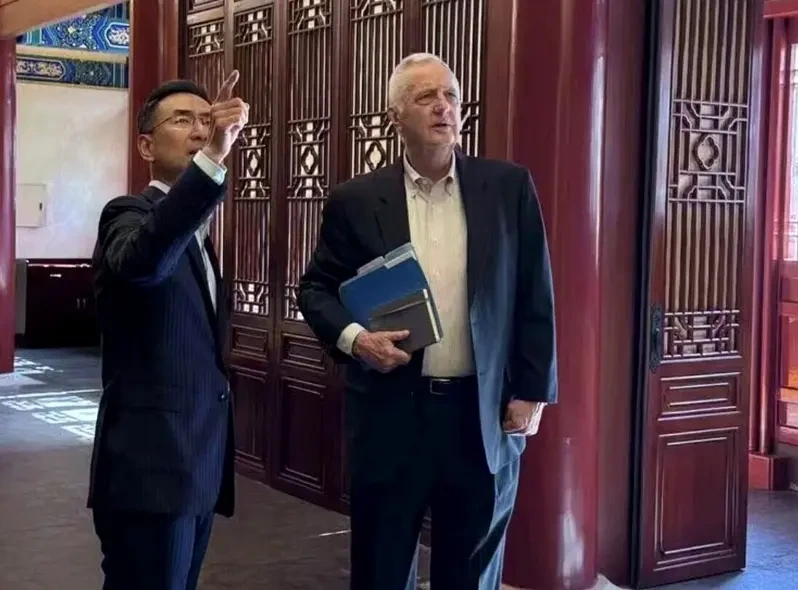
David Shambaugh, a prominent American expert on China—known for his association with the “China collapse” theory—was received on the 19th by Geng Shuang, Vice President of the Chinese People’s Institute of Foreign Affairs (CPIFA). This marks the first time in 11 years that Chinese official channels have publicly hosted Shambaugh, a development viewed as a potential signal of a thaw in relations.
According to a post on the CPIFA’s official WeChat account, Geng Shuang met with Shambaugh—a professor at George Washington University and director of its China Policy Program—on the 19th to exchange views on U.S.-China relations. The official statement did not disclose specific details regarding the discussion.
Shambaugh, 73, is a well-known American scholar of China with a long-standing focus on Chinese politics, foreign policy, and U.S.-China relations. He once maintained close ties with the Chinese academic community; however, his relationship with Chinese authorities took a sharp turn for the worse following the publication of an article linked to the “China collapse” theory in 2015.
Shambaugh first traveled to China for studies following the establishment of diplomatic relations between the U.S. and China in 1979. He studied the Chinese language at Nankai University and Fudan University, and pursued doctoral research in the Department of International Politics at Peking University. Over the years, he was frequently invited to lecture at institutions such as the Central Party School of the Communist Party of China. He also served in the U.S. State Department and the National Security Council, playing a long-term role in the development of U.S. policy toward China. Yet, in March 2015, he published an op-ed in The Wall Street Journal titled “The Coming Chinese Collapse,” which ignited intense controversy in China.
Shambaugh later explained that the headline had been drafted by The Wall Street Journal editors and did not accurately reflect his original intent. He emphasized that he does not, in fact, subscribe to the “China collapse” theory.
According to the Hong Kong-based newspaper Ming Pao, following the publication of that article, relevant Chinese authorities instructed domestic universities and think tanks not to invite or host Shambaugh. Consequently, he was effectively barred from entering China for nine years. It was not until 2024 that he was able to return to Beijing, where he visited the Center for International Security and Strategy at Tsinghua University. Following U.S. President Donald Trump’s visit to China this May, David Shambaugh was once again invited to Beijing, where he delivered a speech at the Center for China and Globalization (CCG)—a Chinese think tank—and engaged with foreign diplomats stationed in China as well as Chinese scholars of international relations. He noted at the time that this was his second visit to Beijing in 11 years. According to Ming Pao, the fact that a Beijing-based diplomatic institution has publicly hosted Shambaugh for the first time in 11 years signals that the controversy surrounding his “collapse” thesis has officially been put to rest.
Regarding U.S.-China relations, Shambaugh wrote in an article for the website China-US Focus in late September that while the two meetings between President Trump and Chinese President Xi Jinping—held in May and September of this year—helped stabilize bilateral ties, the two nations still lack institutionalized communication mechanisms. He further argued that even with improved relations between the two leaders, it remains difficult to eliminate the long-standing structural competition between the United States and China.
发送反馈